
TL;DRSIP trunking connects your phone system to the public network over IP; PRI delivers voice over a legacy ISDN circuit in fixed blocks of 23 channels. SIP scales one channel at a time, provisions in software, reroutes instantly for disaster recovery, and commonly costs materially less per line than PRI.
What is the difference between a SIP trunk and a PRI?
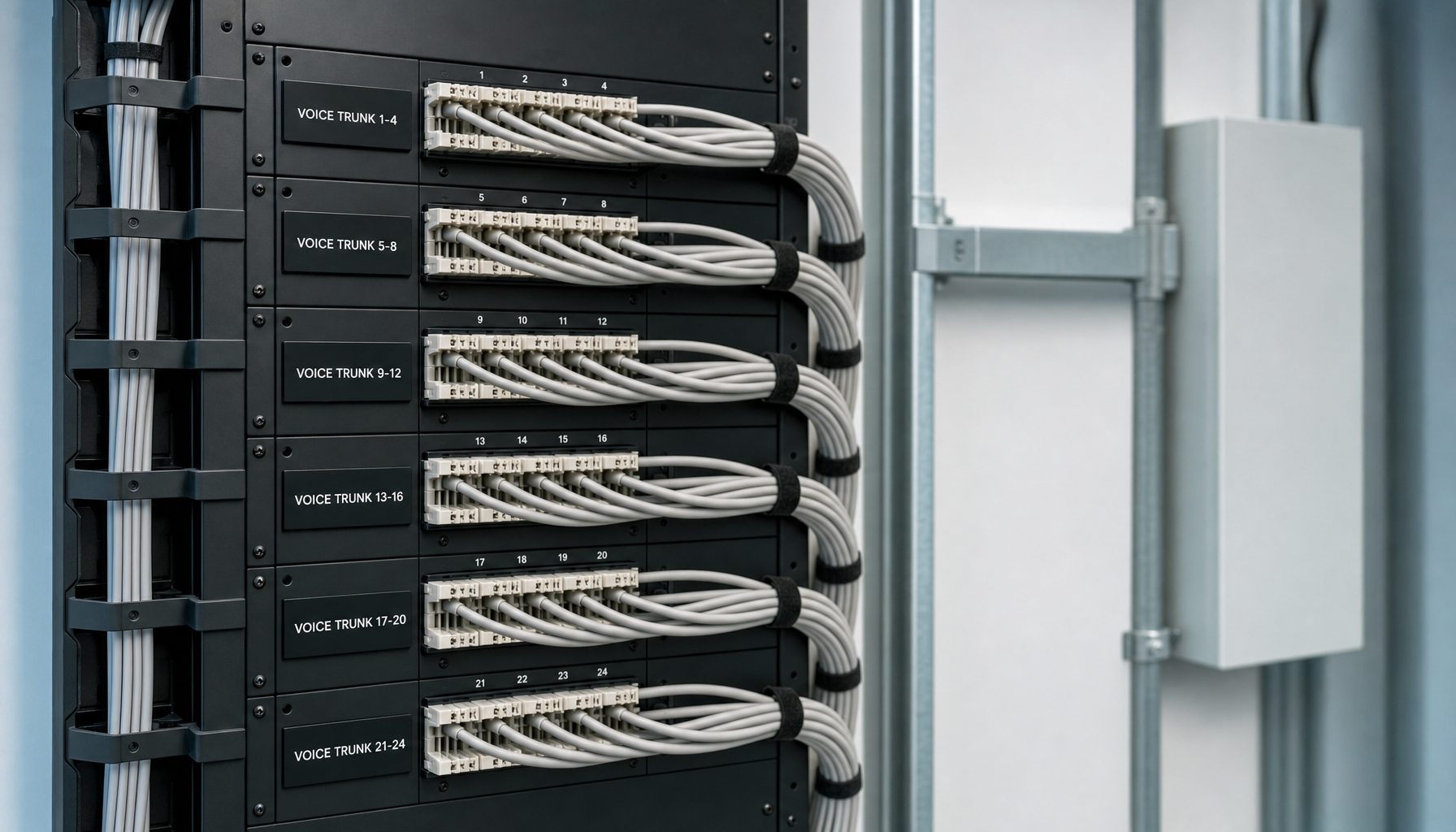
A PRI (Primary Rate Interface) is an ISDN circuit that carries voice over dedicated copper or fiber from the carrier: in North America it delivers 23 concurrent voice channels plus one signaling channel (23B+D) over a T1; in Europe an E1 PRI delivers 30. A SIP trunk carries the same calls as IP to your IP-PBX or session border controller, with concurrent-call capacity provisioned in software instead of physical channels. Both connect your phone system to the public telephone network and both support direct inward dial (DID) numbers. The difference is that one is a fixed physical circuit and the other is a configurable data service.
How does the cost compare?
PRI is priced as a whole circuit plus its channels whether or not you use all 23, and long distance is usually metered. SIP trunking is priced per channel or per concurrent call, frequently with bundled or unlimited domestic calling, and without the cost of maintaining a dedicated TDM circuit. Businesses commonly cut voice line costs materially by moving from PRI to SIP, with widely reported reductions in the range of a third to a half, because you stop paying for idle channels and separate long distance. The exact figure depends on channel count and calling patterns, so the comparison worth trusting is your PRI invoice against a SIP quote sized to your real concurrent-call peak.
Which one scales the way businesses actually grow?
This is where the models diverge most. PRI comes in blocks of 23: if you need a twenty-fourth simultaneous call, you provision a second PRI and pay for 23 more channels you may not use. SIP trunks add or remove capacity one channel at a time, on demand, without a truck roll. Adding numbers or porting DIDs is a software change rather than a circuit order. For a business whose call volume is seasonal, growing, or simply hard to predict, SIP matches capacity to demand in a way fixed PRI blocks cannot.
What happens to each when a site goes down?
A PRI terminates at one physical address; if that building loses power or connectivity, the circuit and the numbers on it are unreachable until service returns. A SIP trunk is not bound to a location, so calls can reroute automatically to another site, a backup data path, or mobile apps within seconds of an outage. That built-in continuity is one of the strongest operational arguments for SIP, and it is difficult and expensive to replicate with PRI. Failover design and recovery targets are defined in your agreement.
When does PRI still make sense, and where is the market going?
PRI still suits sites with a very stable channel count, no reliable business-grade internet, or a legacy PBX that cannot speak SIP without a gateway; its dedicated circuit is not affected by data-network congestion. That case is shrinking, though. PRI rides on the same TDM and copper infrastructure that carriers are retiring worldwide, and new phone systems are IP-native. Most businesses replacing a PBX now connect it with SIP, keeping PRI only as a bridge. Triton VoIP, a Triton Technologies company, sizes SIP trunks to your real concurrent-call peak, secures them behind a session border controller, and can run a hybrid gateway while you transition. Triton Technologies has managed business communications since 2001.